Pricing Your Baking – Without Apology
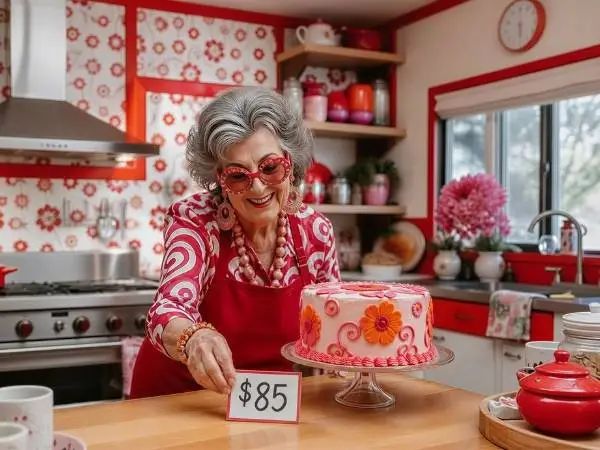
Pricing Your Baking Without Apology (Your Dashboard Does the Maths)
There is a moment in every Nan Made journey where the air goes a bit tight.
It’s not when you turn the oven on. It’s not when you take the photo. It’s not even when you write the description.
It’s when you have to put a number on what you make.
That number is going to sit on your Nan Made listing where everyone can see it: neighbours, friends, family, total strangers. It will decide whether you actually get paid enough to make this worth doing — or whether you quietly keep subsidising everyone else’s sweet tooth with your own bank account.
Nan Made is here to make sure that number is not a guess, not a guilt‑ridden compromise, and definitely not “whatever feels polite.”
Your dashboard already does the maths. Your job is to let it tell the truth, and to stop apologising for that truth.
The invisible maths you’ve been doing for years.
Let’s start with where you’ve come from.
For years — maybe decades — you’ve done pricing like this:
- Someone asks for a cake.
- You think about what you’d like to charge.
- You mentally run through the ingredients and shrug.
- You say a number that sounds “reasonable” and hope you haven’t low‑balled yourself.
- Or worse, you say, “Oh, don’t worry about it,” and watch the grocery bill take the hit instead.
Underneath that, your brain has been doing invisible maths:
- “Flour is expensive now, but I’ll just absorb it.”
- “Butter costs more; I’ll buy the good stuff anyway.”
- “Eggs have gone up. Oh well.”
- “Decorations, boxes, boards, electricity, my time — I’ll just pretend they don’t count.”
You’re not bad at maths. You’re just conditioned to ignore the parts that belong to you.
Nan Made’s pricing tool is here to drag those invisible costs into the light, calmly and clearly.
Your dashboard is not a spreadsheet from hell.
If the word “spreadsheet” makes you want to have a lie‑down, breathe.
Nan Made’s pricing lives in your dashboard, not a scary Excel file someone emailed you. It’s built to feel like a recipe page, not a tax return.
In your dashboard, you have:
- a place where you add a product (your cake, slice, biscuits, scones, jam, etc.),
- a tool where you enter:
- each ingredient,
- what you pay for it,
- how much of it goes into the recipe.
From there, the system:
- calculates your real cost per batch,
- factors in your time and labour (because we are not pretending you are free),
- applies a sensible margin,
- and presents the price you should charge.
You don’t sit there with a calculator and guess. You don’t have to “add a bit for yourself” in your head. The maths is done.
Your job is to respect the number.
What the tool actually sees
Let’s say you’re pricing your famous lemon cake.
You tell the tool:
- flour – what a bag costs, how many grams you use,
- sugar – cost per kilo, grams used,
- eggs – price per dozen, eggs used,
- butter – price per block, grams used,
- lemons – price per kilo, number used,
- icing sugar, decorations, boxes, boards, baking paper.
You add:
- approximate time for prep, baking, cooling, icing and cleaning up (yes, cleaning),
- how many servings your cake yields.
The tool then knows:
- exact ingredient cost for one cake,
- realistic time cost for one cake,
- how many people that one cake feeds.
It combines those into:
- a base cost (ingredients + overhead + time),
- a margin (so you’re not just breaking even),
- a final price that pays you.
You can tweak that price slightly — round it up or down, adjust for your local market — but the foundation is solid.
If you imagine this like building a house, the price the tool gives you is the slab. You can paint the walls how you like, but you don’t dig up the concrete.
Why guessing is dangerous
When you ignore the tool and go back to guessing, you do three things:
1. You underpay yourself
- “$35 sounds okay…”
- Except the tool knows your real cost is $32 before you even pay yourself.
2. You teach your buyers to expect cheap baking
- Once they’ve paid $35 for something that should have been $65, they’ll flinch when you correct it later.
3. You quietly join the line of older women doing unpaid or underpaid work
- in a country where women over fifty are already carrying the weight of poverty and housing stress at far higher rates than they should. [aph.gov](https://www.aph.gov.au/DocumentStore.ashx?id=df4cebe8-0c78-4010-8ab0-ee50bbfda926&subId=684610)
Nan Made is not here to make you another woman who “gets by.” Nan Made is here to help you price your baking as if it’s work, because it is.
Money is not just numbers. It’s what those numbers unlock.
For women in their fifties, sixties, seventies and eighties, money is not about buying more stuff.
It is about:
- control – having money in your own name, that you can spend or save without needing permission.
- safety – being able to pay rent, bills and food reliably.
- options – being able to leave a situation, or choose a different path, because you can afford to.
- peace of mind – knowing there is something in the account if the car breaks down, a tooth cracks, or a family member needs support.
When you let your dashboard price your baking properly, you are not being “greedy.” You are:
- building control,
- building safety,
- building options,
- building peace.
That is what this price is for.
Let’s talk numbers without whispering
Here’s the part where we stop dodging it and look straight at the maths.
You price your lemon cake at $70 because the tool tells you that:
- your ingredients and time cost $40,
- you deserve a margin that pays you something more than a pat on the back.
If you sell:
- 1 cake a week → approx $280/month.
- 2 cakes a week → approx $560/month.
- 3 cakes a week → approx $840/month.
You can adjust the numbers to fit your actual prices, but the pattern holds.
For many women, those amounts are:
- rent money,
- electricity money,
- medicine money,
- “I can go to the dentist” money,
- “if I have to leave, I have something” money.
When you look at your dashboard and see those amounts stacking up, your brain needs to know:
“This isn’t extra. This is essential.”
“Won’t people think it’s too expensive?”
Some will. That’s fine.
They are used to:
- paying less for mass‑produced food that doesn’t taste or feel like yours,
- quietly expecting older women to bake for free or “cost price,”
- living in a world that discounts women’s labour as long as it’s wrapped in love.
You are offering:
- real baking,
- made by a real woman with decades of skill,
- in a real kitchen,
- with emotional weight and memory baked in.
That costs more than a generic supermarket tray. It should.
If someone balks, they are welcome to buy the cheap thing. They will taste the difference, and so will you.
The emotional storm — and how to walk through it
Let’s be honest: the first time you see a bold price next to your name, you might feel:
- a rush of guilt,
- a flash of shame,
- a fear that people will judge you,
- a squeeze in your chest that says “Is this allowed?”
That’s not the price being wrong.
That’s all the years of doing unpaid work, all the “can you just whip something up” moments, all the times you’ve made yourself smaller to keep the peace, trying to stay in charge.
You don’t have to fight those feelings. You just have to keep going.
Take these steps:
1. Leave the price where it is.
Do not rush to slash it in half. Give it a chance.
2. Publish the listing.
Let the cake exist in the world at the price it deserves.
3. Send the link to people who already love your baking.
“I’ve put my cakes up on Nan Made — if you’d like one, you can order here.”
4. Watch what happens.
Some will hesitate. Many will say, “About time.” Some will simply order and move on.
Over time, your feelings will catch up with reality:
“This is what my work costs. People are paying it. I am allowed to receive this.”
Your dashboard is your mirror
A lot of women over fifty don’t have a clear picture of what their labour is worth because nobody has ever bothered to show them.
Your Nan Made dashboard does that, quietly.
It shows you:
- what your products cost to make,
- how your prices stack up,
- how many orders you’ve had,
- how much money has moved toward you.
It is a mirror that reflects your baking as a business, not as a favour.
If you log in and see that underpricing is still happening, that mirror is not criticising you. It’s inviting you to adjust.
You can:
- review your ingredient costs,
- double‑check quantities,
- re‑run the pricing,
- raise your prices where they need raising.
Each adjustment is a small act of self‑respect.
When pricing becomes an act of love
It might sound strange, but properly pricing your baking is a form of love.
It is love for:
- your body — you stop overworking for free.
- your mind — you stop carrying unspoken resentment.
- your future — you stop leaving your safety to chance.
- other women — you show them what’s possible when a woman refuses to undervalue herself.
Every time you let the tool speak and accept its answer, you are saying:
“I matter. My work matters. My future matters.”
That stance ripples.
- A friend sees your price and thinks about her own.
- A daughter watches you start a business and realises she doesn’t have to apologise for her rate.
- A neighbour, another woman over fifty, hears you talk about Nan Made and takes the first step toward listing her own baking.
Pricing is contagious in the best way.
How to talk about your prices out loud
When someone asks, “How much is your cake?” you don’t need to get defensive or apologetic.
Try this:
> “My lemon cake is $70. That includes all ingredients, my time, and a proper finish. You order it through Nan Made and it comes straight to you.”
If they say, “Wow, that’s a bit steep,” you can reply:
> “It’s priced to reflect what it actually costs to make. If you’d prefer something cheaper, the supermarket has options — they just don’t taste like this.”
or, with a softer smile:
> “It’s priced fairly. I run this as a proper baking business now. People are very happy with what they get.”
You’re not arguing. You’re stating facts.
Your prices are not up for debate. They are up for acceptance or declining. That’s it.
The point of “without apology”
“Pricing your baking without apology” doesn’t mean you never feel anything. You will.
It means you stop letting those feelings dictate your numbers.
Apology‑pricing sounds like:
- “Oh, I’ll just charge $30.”
- “I know it’s a bit expensive, sorry.”
- “I can knock something off for you.”
Non‑apology pricing sounds like:
- “My cake is $70.”
- “Here’s the link.”
- “If that works for you, I’d love to bake for you.”
One is a woman shrinking herself.
The other is a woman standing in what she’s worth.
The invitation
Nan Made has done the hardest part:
- built the platform,
- built the pricing tool,
- built the process,
- built the story that says, “Your baking can fund your life.”
Your part is to:
- use the tool,
- trust the numbers,
- set the prices,
- and hold the line.
You’re not being difficult. You’re being deliberate.
You’re not being greedy. You’re being honest.
You’re not being “too much.” You’re being enough, properly, for the first time in a long time.
Every fairly‑priced cake is a small, fierce piece of the world we’re building: one where women over fifty don’t have to choose between giving their love and paying their bills.
You can have both.
Your dashboard already knows how. It’s time to let it.